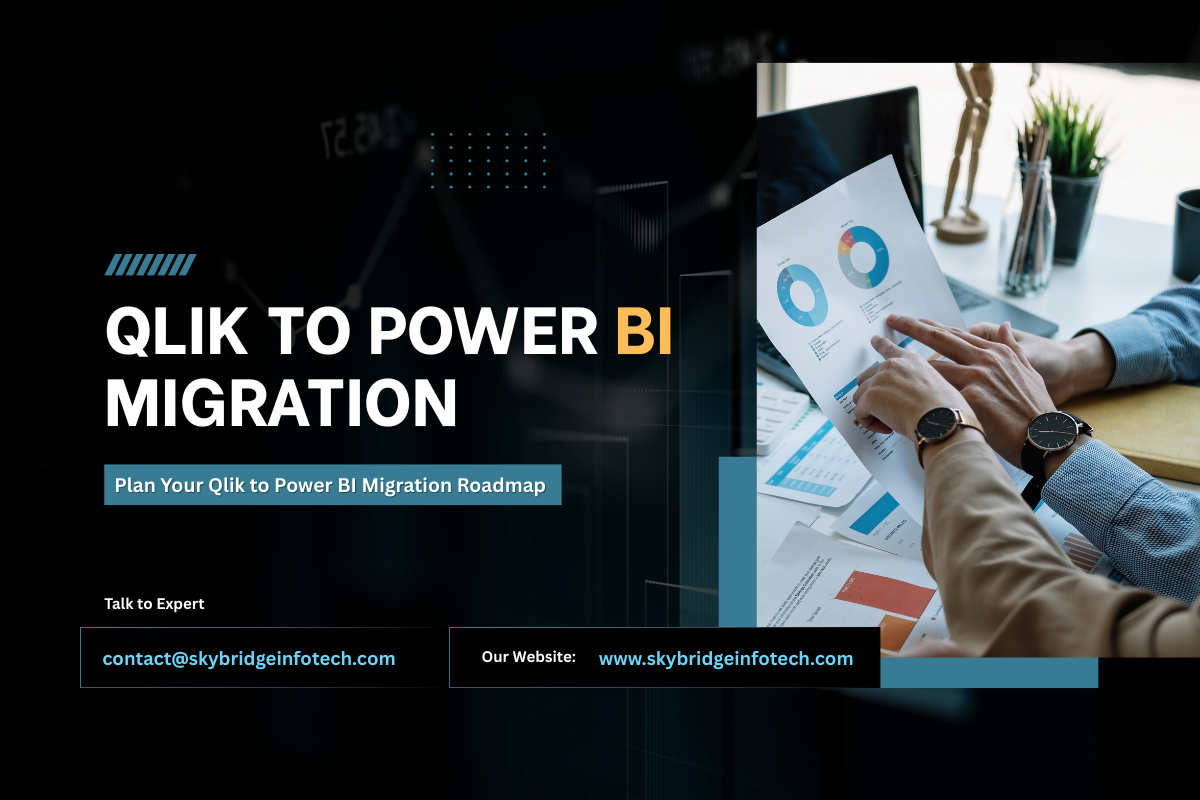
Planning a Successful Qlik to Power BI Migration Roadmap with Skybridge Infotech
As enterprises evolve their analytics capabilities, many are rethinking their long-term reliance on Qlik. Growing data volumes, increasing cloud adoption, and deeper integration with Microsoft platforms are driving organizations toward Power BI. However, a Qlik to Power BI migration is rarely successful when treated as a simple technology switch. Without a structured roadmap, migrations can disrupt business reporting, introduce performance issues, and slow user adoption. At Skybridge Infotech, we help enterprises plan and execute Qlik to Power BI migration roadmaps that are practical, low-risk, and designed for long-term analytics maturity.
Why a Migration Roadmap Is Critical
Many organizations begin with a broad objective: “Move all Qlik dashboards to Power BI.”
While straightforward in theory, this approach often leads to avoidable challenges.
Without a clear roadmap:
- Business-critical dashboards may be migrated too late or incorrectly
- Hidden dependencies emerge mid-project
- Legacy design and technical debt are carried forward
- Users struggle to adapt to the new platform
A well-defined migration roadmap ensures the transition is controlled, prioritized, and aligned with business outcomes, not just timelines.
Common Challenges in Qlik to Power BI Migrations
Before planning the roadmap, it’s important to recognize where enterprises typically struggle:
- Large numbers of Qlik apps with unclear ownership or usage
- Complex transformation logic embedded in Qlik scripts
- Performance issues caused by legacy data models
- Inconsistent security and governance practices
- Limited Power BI readiness among business users
These challenges highlight why migration planning must go beyond dashboard conversion.
Skybridge Infotech’s Roadmap-Driven Migration Approach
Skybridge Infotech follows a phased, execution-focused migration roadmap designed specifically for enterprise environments.
Phase 1: Discovery and Current-State Assessment
We start by understanding how Qlik is actually used across the organization.
This phase includes:
- Inventory of Qlik applications, dashboards, and scripts
- Usage analysis to identify high-value and low-value assets
- Review of data sources, transformations, and dependencies
- Identification of performance, security, and governance gaps
Outcome: A clear picture of what should be migrated, modernized, or retired.
Phase 2: Migration Strategy and Prioritization
Not every dashboard needs to be migrated immediately—or at all.
Skybridge helps enterprises:
- Prioritize dashboards based on business impact
- Group reports into logical migration waves
- Define success metrics and realistic timelines
- Align migration with business cycles and dependencies
Outcome: A practical migration plan that minimizes disruption.
Phase 3: Architecture and Data Model Design
A successful migration depends on getting the foundation right.
We:
- Design Power BI semantic models using best practices
- Translate Qlik logic into optimized DAX measures
- Modernize data integration using Azure, Fabric, or other platforms
- Define standardized security and governance models
Outcome: A scalable, future-ready analytics architecture.
Phase 4: Power BI Development and Validation
With the foundation in place, we move into execution.
This phase includes:
- Power BI report development focused on usability and performance
- Data validation and parallel runs with Qlik
- Stakeholder reviews and refinements
- Performance tuning and optimization
Outcome: Trusted Power BI reports ready for enterprise use.
Phase 5: User Enablement and Transition
Migration success depends on adoption, not just delivery.
Skybridge supports:
- Training for business users and analysts
- Documentation and Power BI best practices
- Controlled transition from Qlik to Power BI
- Feedback-driven improvements
Outcome: Smooth adoption with minimal resistance.
Phase 6: Decommissioning and Continuous Optimization
Migration doesn’t end at go-live.
We help enterprises:
- Gradually decommission Qlik assets
- Optimize Power BI performance and governance
- Monitor usage and adoption trends
- Prepare for advanced analytics and AI use cases
Outcome: Reduced costs and continuous analytics improvement.
Why Enterprises Choose Skybridge Infotech
Skybridge Infotech combines deep BI expertise with execution discipline.
Our migration roadmaps are:
- Business-driven, not tool-driven
- Designed for enterprise scale and complexity
- Focused on long-term analytics maturity
- Backed by strong Power BI and Microsoft ecosystem expertise
We don’t just migrate dashboards—we build analytics platforms that scale and last.
Final Thoughts
A successful Qlik to Power BI migration starts with a well-planned roadmap. When executed with the right strategy, architecture, and change management, migration becomes an opportunity to modernize analytics rather than a risk to business operations. With Skybridge Infotech, enterprises gain a trusted partner to plan and deliver structured, scalable, and future-ready Qlik to Power BI migration roadmaps.