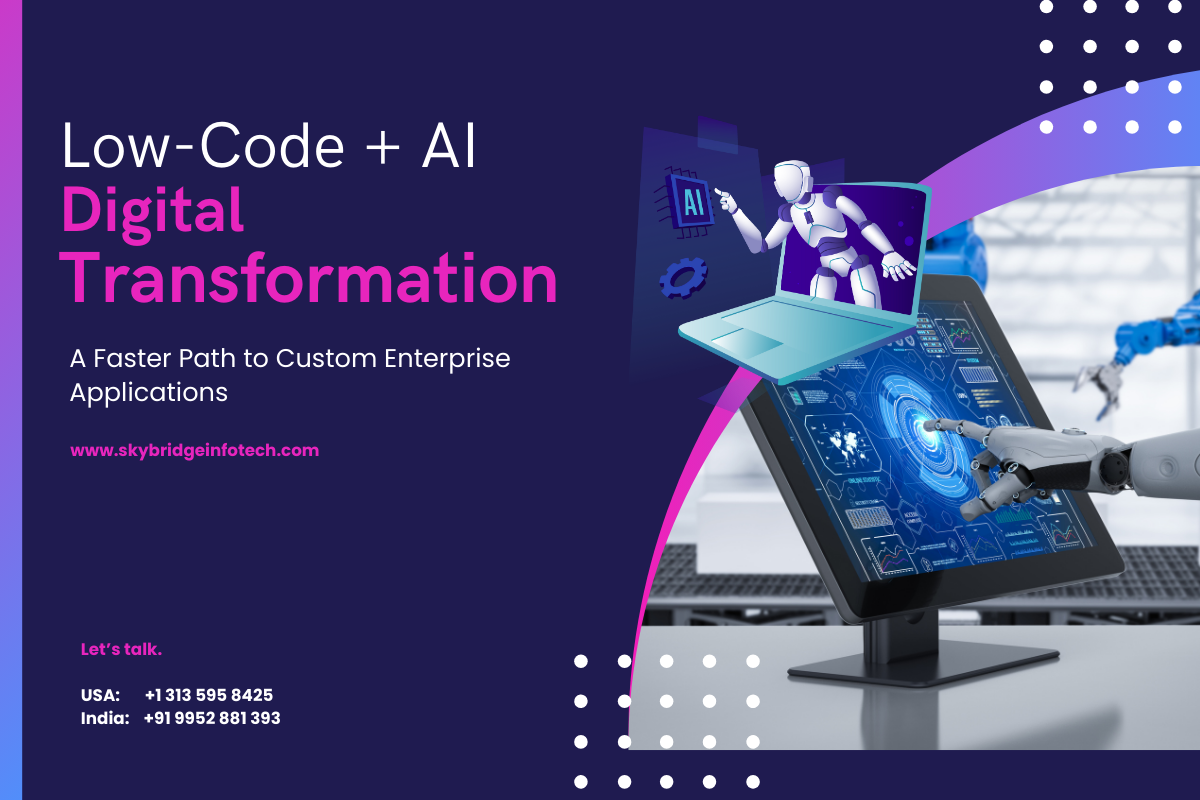
Low-Code + AI for Digital Transformation: A Faster Path to Custom Enterprise Applications
Digital transformation initiatives often stall for a simple reason: building enterprise-grade applications takes too long. Traditional development models struggle to keep pace with changing business needs, while IT teams are stretched managing legacy systems, security, and scalability.
Low-code platforms, when combined with AI, are changing that equation. Together, they offer enterprises a faster, more intelligent path to building custom applications—without sacrificing governance, performance, or flexibility.
The Enterprise Application Bottleneck
Most enterprises face similar challenges when delivering new digital capabilities:
- Long development cycles that delay business outcomes
- Growing backlogs of application requests
- Heavy reliance on scarce development resources
- Difficulty modernizing legacy workflows quickly
Low-code platforms address speed. AI adds intelligence. When combined, they unlock a new model for enterprise application delivery.
What Happens When Low-Code Meets AI?
Low-code + AI goes beyond drag-and-drop development. It enables organizations to build applications that are not only faster to create, but also smarter by design.
AI enhances low-code platforms by enabling:
- Intelligent workflow automation and decision-making
- Predictive insights embedded directly into applications
- Natural language interfaces for faster configuration
- Automated testing, optimization, and performance tuning
The result is custom enterprise applications that evolve with business needs rather than becoming rigid over time.
How Low-Code + AI Accelerates Digital Transformation
1. Faster Time-to-Value
Low-code accelerates application delivery by abstracting repetitive development tasks. AI further speeds up the process by recommending components, generating logic, and identifying potential issues early. Enterprises move from idea to deployment in weeks instead of months.
2. Smarter Business Workflows
AI-enabled applications can analyze historical data, detect patterns, and make real-time recommendations. This transforms static workflows into adaptive systems that improve efficiency and decision-making.
3. Reduced Dependency on Hard-to-Find Skills
Low-code empowers business and IT teams to collaborate more effectively. AI-assisted development reduces manual effort and complexity, allowing skilled developers to focus on high-value innovation rather than routine coding.
4. Modernization Without Disruption
Low-code + AI platforms integrate with existing enterprise systems, enabling incremental modernization. Organizations can digitize legacy processes without large-scale rewrites or business disruption.
5. Built-In Governance and Scalability
When implemented correctly, low-code + AI solutions align with enterprise security, compliance, and scalability requirements—ensuring speed does not come at the cost of control.
Real-World Use Cases
Enterprises are already leveraging low-code + AI to:
- Automate approvals, onboarding, and compliance workflows
- Build AI-driven dashboards and decision-support tools
- Create intelligent customer and employee self-service applications
- Rapidly prototype and scale internal business applications
These use cases demonstrate how speed and intelligence together drive meaningful transformation.
Skybridge Infotech’s Approach to Low-Code + AI
At Skybridge Infotech, we take an execution-first approach. We help enterprises identify where low-code + AI delivers the highest impact—and where traditional development is still the right choice.
Our methodology includes:
- Assessing business processes and application backlogs
- Selecting the right low-code platforms aligned to enterprise architecture
- Embedding AI capabilities that solve real business problems
- Ensuring governance, security, and long-term scalability
We focus on outcomes, not just tools.
Building the Right Applications, Faster
Low-code + AI is not about replacing developers or creating shortcuts. It is about enabling enterprises to respond faster, innovate continuously, and build applications that learn and improve over time. For organizations pursuing digital transformation, this combination represents a practical, scalable path forward—turning application development into a strategic advantage rather than a bottleneck.
The future of enterprise applications is faster, smarter, and more adaptive—and it is being built with low-code and AI.