From Qlik to Power BI: Skybridge Infotech’s Migration Framework Explained
For many enterprises, Qlik has been a reliable analytics platform for years. However, as data estates grow, cloud adoption accelerates, and Microsoft ecosystems become more central to enterprise IT, organizations are increasingly asking a critical question:
Is Qlik still the right platform for our future analytics needs?
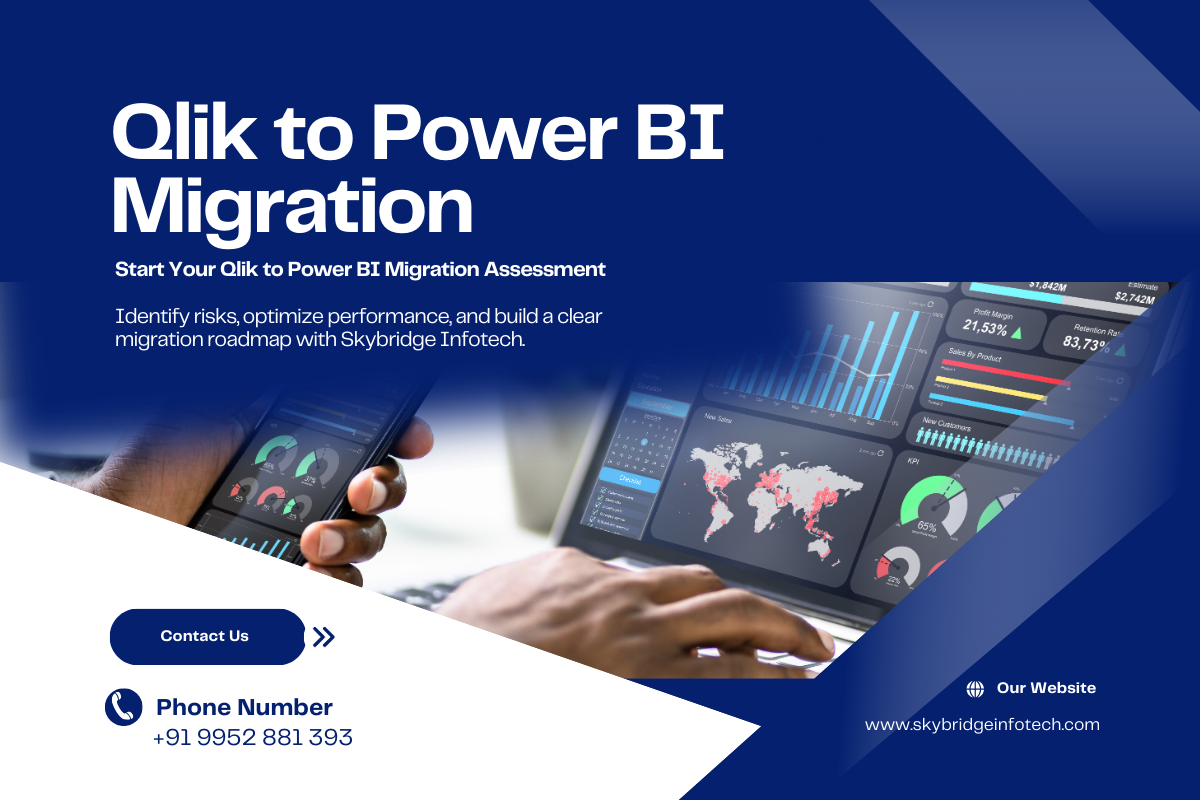
This is where Power BI enters the conversation—and where migrations often become more complex than initially expected. At Skybridge Infotech, we’ve seen that successful Qlik-to-Power BI migrations are not about tool replacement; they are about modernizing analytics with minimal business disruption.
This blog explains how Skybridge Infotech approaches Qlik to Power BI migrations through a proven, execution-driven framework.
Why Enterprises Are Moving from Qlik to Power BI
Organizations typically consider migration when they encounter one or more of these challenges:
- Rising licensing and infrastructure costs with Qlik
- Limited alignment with Microsoft Azure, Fabric, and Microsoft 365
- Increasing demand for self-service analytics at scale
- Difficulty standardizing governance and security across BI assets
- Performance constraints with growing data volumes
Power BI offers strong advantages—tight Microsoft integration, lower total cost of ownership, scalable cloud architecture, and faster innovation cycles. However, real value only emerges when migration is done strategically, not through report-by-report recreation.
Skybridge Infotech’s Migration Philosophy
At Skybridge, we believe analytics migration should improve outcomes, not just replicate visuals.
Our approach focuses on:
- Preserving business logic and insights
- Improving performance and data models
- Reducing long-term maintenance overhead
- Enabling future-ready analytics on Microsoft platforms
This philosophy shapes our structured migration framework.
The Skybridge Qlik to Power BI Migration Framework
1. Discovery and BI Landscape Assessment
We begin by understanding how Qlik is actually used—not how it was designed.
This phase includes:
- Inventory of Qlik apps, dashboards, and scripts
- Usage analysis to identify business-critical reports
- Evaluation of data sources, transformations, and dependencies
- Identification of redundant or low-value assets
Outcome: A clear migration roadmap that prioritizes high-impact dashboards and eliminates unnecessary rework.
2. Semantic Model Redesign (Not One-to-One Replication)
One of the most common migration mistakes is attempting a direct visual-to-visual conversion.
Skybridge instead:
- Redesigns Qlik data models into optimized Power BI semantic models
- Translates Qlik expressions into efficient DAX measures
- Improves star schema design for better performance
- Aligns models with enterprise data governance standards
Outcome: Faster reports, cleaner models, and a foundation that scales.
3. Data Integration and Modernization
Qlik scripts often embed complex transformation logic that can become technical debt over time.
Our approach:
- Extracts and rationalizes transformation logic
- Moves data processing to Azure SQL, Synapse, Fabric, or other modern platforms
- Reduces dependency on BI-layer transformations
- Improves data refresh reliability and performance
Outcome: A modern analytics architecture that supports real-time, batch, and future AI use cases.
4. Power BI Report Development and UX Optimization
Instead of recreating Qlik dashboards pixel by pixel, we focus on how users consume insights.
Skybridge designs Power BI reports that:
- Follow Microsoft’s best practices for usability and accessibility
- Improve storytelling with intuitive layouts
- Standardize KPIs and visual patterns across reports
- Enable self-service exploration without breaking governance
Outcome: Higher adoption and better decision-making across business teams.
5. Security, Governance, and Performance Tuning
Migration is incomplete without enterprise-grade controls.
We implement:
- Role-Level Security (RLS) aligned with organizational hierarchies
- Workspace and dataset governance models
- Performance optimization using aggregation, incremental refresh, and DAX tuning
- Monitoring and usage analytics
Outcome: Secure, compliant, and high-performing Power BI environments.
6. User Enablement and Change Management
Even the best dashboards fail if users don’t adopt them.
Skybridge supports:
- Business user training and onboarding
- Power BI best practices documentation
- Transition support for Qlik users
- Post-migration optimization based on real usage
Outcome: Smooth adoption with minimal resistance from business teams.
What Makes Skybridge Infotech Different
Unlike generic migration approaches, Skybridge combines BI expertise with digital transformation thinking:
- Execution-led, not tool-led migrations
- Deep experience across Qlik, Power BI, and Microsoft data platforms
- Focus on long-term analytics maturity—not just go-live
- Proven success with enterprise-scale BI transformations
We don’t just migrate dashboards—we future-proof analytics ecosystems.
Final Thoughts
Migrating from Qlik to Power BI is a strategic decision that impacts how your organization uses data for years to come. When done correctly, it unlocks better performance, lower costs, and stronger alignment with modern digital platforms. With Skybridge Infotech’s structured migration framework, enterprises move beyond simple BI conversion and toward scalable, governed, and insight-driven analytics.
If your organization is evaluating a Qlik to Power BI migration, Skybridge Infotech can help you do it right—the first time.