
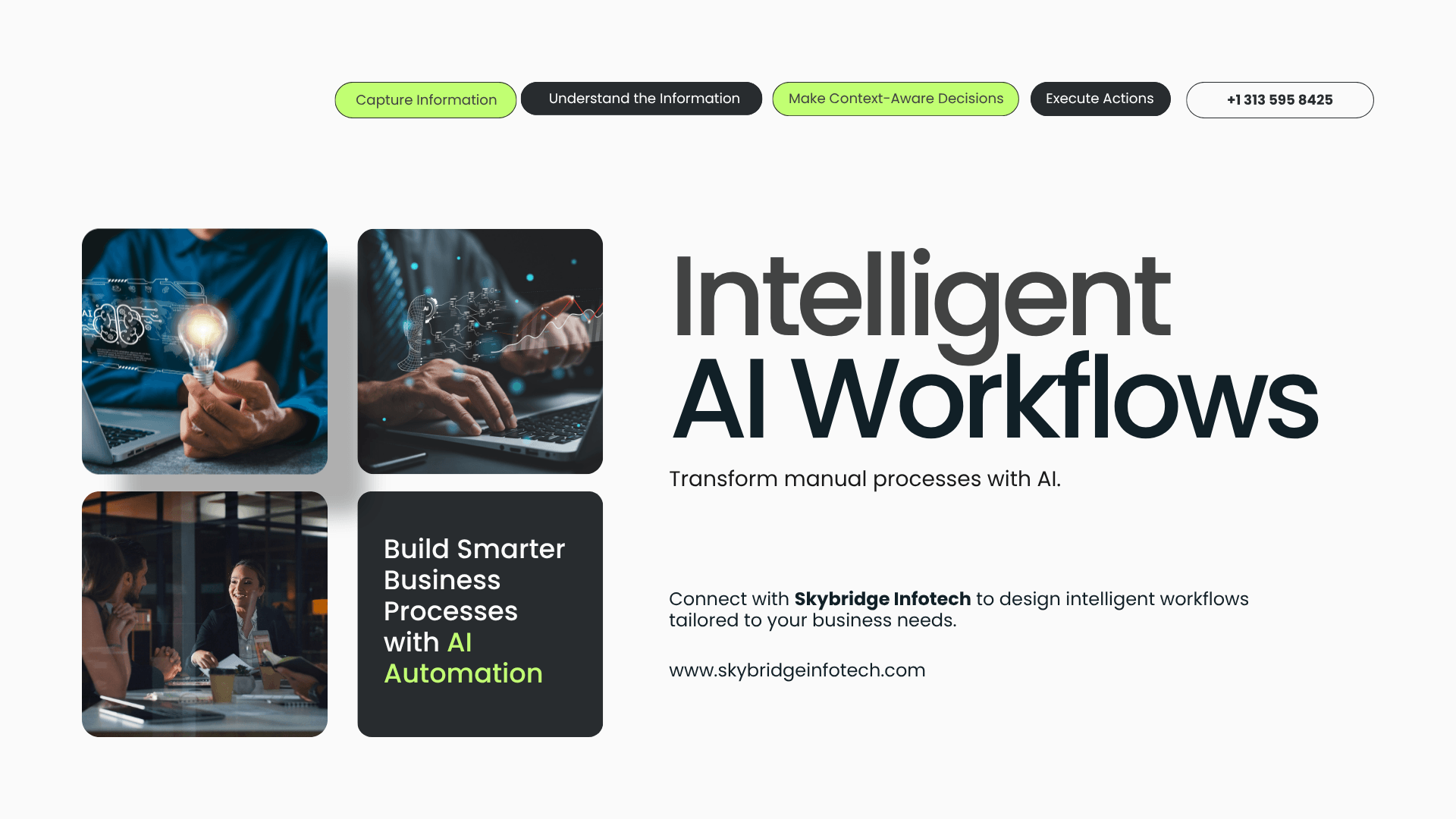
Replacing Manual Business Processes with Intelligent AI Workflows
Many businesses still depend on manual processes to keep everyday operations moving. Employees review documents, enter data, route requests, update systems, respond to routine questions, and follow up on tasks that often follow the same pattern.
These processes may work, but they can consume valuable time and create unnecessary delays. Manual work can also increase the risk of errors, inconsistent decisions, and missed follow-ups.
This is where AI workflow automation can make a meaningful difference.
Instead of simply automating individual tasks, businesses can use AI to connect multiple steps, understand information, make decisions, and trigger the next action automatically. The result is a more intelligent workflow that helps employees focus on higher-value work while routine processes continue in the background.
What Is AI Workflow Automation?
AI workflow automation combines artificial intelligence with business process automation to manage workflows that traditionally require human intervention.
Traditional automation generally follows predefined rules: if something happens, perform a specific action.
AI-powered workflows can go further. They can analyze unstructured information, understand context, classify requests, identify patterns, generate responses, and determine what should happen next based on business rules and available data.
For example, instead of an employee manually reviewing every incoming customer request, an AI workflow can:
- Receive the request.
- Understand and classify the customer’s intent.
- Extract relevant information.
- Check business rules or connected systems.
- Route the request to the appropriate team.
- Generate a response where appropriate.
- Update the relevant business system.
- Escalate exceptions to a human employee.
This creates a connected process rather than a collection of isolated automated tasks.
Why Businesses Are Moving Beyond Manual Processes
Manual processes become increasingly difficult to manage as organizations grow. More customers, employees, transactions, documents, and systems mean more work for teams to coordinate.
Common challenges include:
- Repetitive administrative work
- Slow approval and request processing
- Manual data entry
- Information scattered across multiple systems
- Delayed customer responses
- Inconsistent execution of business processes
- Employees spending time on low-value tasks
- Difficulty scaling operations without increasing headcount
AI business process automation helps organizations address these challenges by combining automation, intelligence, and system integration.
The goal is not necessarily to remove people from the process. Instead, it is to give employees intelligent digital support that handles repetitive work and allows people to concentrate on decisions, relationships, strategy, and exceptions.
How Intelligent AI Workflows Work
An intelligent workflow typically connects people, applications, data, and AI capabilities into a coordinated process.
1. Capture Information
The workflow receives information from sources such as emails, forms, documents, chat interactions, applications, or business systems.
2. Understand the Information
AI can analyze the incoming information and identify important details. This is particularly useful when information is unstructured, such as emails, invoices, contracts, support requests, or customer messages.
3. Make Context-Aware Decisions
Based on business rules, historical information, organizational policies, and available data, the workflow can determine the appropriate next step.
4. Execute Actions
The workflow can update systems, create records, send notifications, route requests, generate documents, or initiate other processes.
5. Involve Humans When Needed
Not every decision should be automated. Intelligent workflows can identify exceptions and send them to the right employee for review.
This human-in-the-loop approach provides a practical balance between automation and human oversight.
Examples of Business Process Automation with AI
AI-powered workflows can be applied across many departments and industries.
Customer Service
AI can classify customer requests, identify urgent issues, retrieve relevant information, draft responses, and route complex cases to the appropriate support team.
Finance and Accounting
AI workflows can assist with invoice processing, document extraction, payment approvals, expense reviews, and financial data reconciliation.
Human Resources
Organizations can automate employee onboarding workflows, document collection, HR requests, policy questions, and routine employee communications.
Sales Operations
AI can help qualify leads, summarize customer interactions, update CRM records, generate follow-up tasks, and support sales teams with relevant information.
IT Operations
AI workflows can classify support tickets, troubleshoot common issues, route incidents, and escalate problems based on severity and business impact.
Document and Contract Processing
AI can extract information from documents, classify files, identify important clauses, summarize content, and route documents for approval or review.
AI Automation vs. Traditional Automation
Traditional automation remains valuable for structured and predictable processes. However, many business workflows involve information that does not fit neatly into predefined fields.
For example, a rule-based system may know what to do when a form contains a specific value. An AI-powered system can also interpret an email written in natural language and determine what the person is asking for.
This makes AI workflow solutions particularly useful for processes involving:
- Natural-language communication
- Unstructured documents
- Multiple data sources
- Context-dependent decisions
- Classification and summarization
- Variable customer or employee requests
- Processes requiring human escalation
The strongest approach is often a combination of traditional automation and AI rather than replacing one with the other.
Benefits of Intelligent AI Workflows
When implemented strategically, AI workflow automation can provide several business benefits.
Reduce repetitive work: Employees spend less time on routine administrative tasks.
Improve operational speed: Automated workflows can process requests and move tasks forward without waiting for manual intervention at every step.
Increase consistency: Standardized workflows help ensure that processes are executed according to defined policies.
Reduce errors: Automating repetitive data handling can reduce common manual-entry mistakes.
Scale operations: Businesses can handle increasing workloads without relying entirely on additional manual effort.
Improve employee productivity: Employees can spend more time on complex decisions, customer relationships, innovation, and strategic work.
Create better visibility: Connected workflows can provide greater insight into where processes are delayed and where improvements are needed.
Building an Effective AI Workflow Strategy
AI automation should not begin with technology alone. Businesses should first identify where automation can create measurable value.
A practical approach includes:
Identify repetitive processes: Look for workflows that consume significant employee time or create operational bottlenecks.
Map the existing process: Understand every step, system, decision point, and exception.
Prioritize high-value opportunities: Start with processes where automation can produce measurable improvements.
Connect business systems: Integrate AI workflows with CRM, ERP, HR, finance, service, and other enterprise applications where appropriate.
Define human oversight: Establish clear boundaries for automated decisions and determine when human review is required.
Monitor performance: Track workflow accuracy, processing time, exceptions, cost savings, and business outcomes.
The Future of Business Automation Is More Intelligent
The next generation of business automation is moving beyond simple task automation toward intelligent, connected workflows.
AI can help organizations understand information, make context-aware decisions, and coordinate actions across multiple systems. When combined with appropriate governance and human oversight, these capabilities can transform how businesses operate.
The key is to automate strategically—not simply automate everything.
Businesses that identify the right processes, connect their systems, establish responsible AI controls, and continuously optimize their workflows can create operations that are faster, more scalable, and more adaptable.
Transform Manual Processes with AI
Replacing manual processes does not have to mean rebuilding your entire operation. The right AI workflow strategy can start with a single high-impact process and expand as the organization demonstrates value.
Skybridge Infotech helps businesses explore and implement AI workflow automation, AI business process automation, business process automation with AI, and AI workflow solutions designed around real business requirements.
From identifying automation opportunities to designing intelligent workflows and integrating enterprise systems, the focus is on creating practical AI solutions that deliver measurable business value.
Ready to identify where AI can improve your business processes? Talk to Skybridge Infotech about your AI workflow automation strategy.