Upgrade Your Operations with Enterprise AI Workflow Automation
Running a modern business is not just about working harder anymore. It is about working smarter. Companies today handle massive amounts of data, repetitive tasks, customer requests, approvals, reports, and operational processes every single day. Managing all of this manually slows teams down and increases the chances of errors.
This is why more businesses are investing in enterprise AI workflow automation.
AI-powered automation helps organizations simplify operations, reduce manual work, and improve decision-making across departments. From finance and HR to customer service and supply chain management, automation is changing how businesses operate at scale.
For companies looking to improve efficiency and gain better visibility into operations, combining business intelligence services with enterprise data automation with AI can create a major competitive advantage. As an experienced technology partner, Skybridge Infotech helps businesses modernize workflows with intelligent automation solutions designed for growth.
In this article, we will explore how enterprise AI workflow automation works, why it matters, and how businesses can use it to improve operations and productivity.
What Is Enterprise AI Workflow Automation?
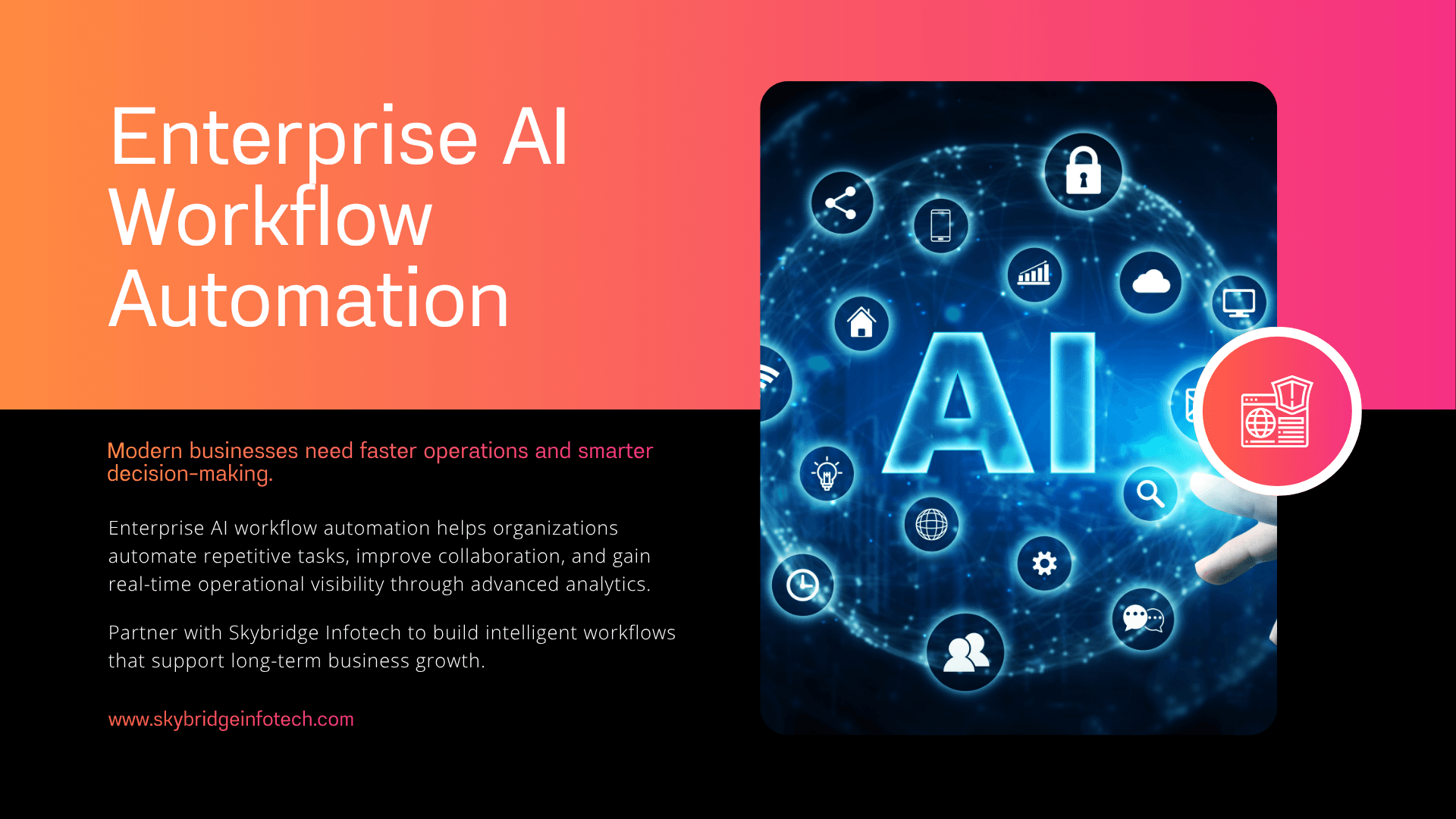
Enterprise AI workflow automation uses artificial intelligence and automation technologies to streamline repetitive business processes.
Instead of relying on manual approvals, spreadsheet tracking, or repetitive administrative work, AI systems automate these tasks using predefined rules, machine learning, and real-time data analysis.
This can include:
- Automated invoice processing
- Customer support workflows
- Employee onboarding
- Data entry automation
- AI-powered reporting
- Inventory management
- Workflow approvals
- Predictive maintenance
- Document processing
The goal is simple: reduce operational bottlenecks and help employees focus on higher-value work.
Why Businesses Are Moving Toward AI Automation
Many businesses still rely on outdated workflows that consume time and resources. Employees spend hours manually updating reports, entering data, forwarding approvals, or searching for information across disconnected systems. Over time, these inefficiencies reduce productivity and slow business growth. Enterprise AI workflow automation solves this problem by creating faster, smarter, and more connected operations.
Businesses adopting AI-driven automation often experience:
- Faster process execution
- Reduced operational costs
- Improved data accuracy
- Better employee productivity
- Real-time decision-making
- Higher customer satisfaction
When combined with modern business intelligence services, AI automation also provides better visibility into operational performance and business trends.
How AI Workflow Automation Improves Operations
1. Eliminates Repetitive Manual Tasks
One of the biggest advantages of automation is reducing repetitive work.
Tasks like data entry, invoice approvals, scheduling, and report generation can all be automated using AI-powered workflows.
This reduces human error while saving employees valuable time.
Instead of focusing on repetitive administration, teams can spend more time on strategy, customer engagement, and innovation.
2. Improves Decision-Making with Real-Time Insights
Automation becomes even more powerful when connected to analytics platforms.
Businesses can use business intelligence services to monitor workflow performance, track KPIs, and identify operational bottlenecks in real time.
For example, managers can instantly see:
- Delayed approvals
- Customer response times
- Workflow completion rates
- Inventory shortages
- Employee productivity metrics
AI systems can also generate predictive insights that help businesses prepare for future challenges before they happen.
3. Enhances Data Accuracy
Manual workflows often lead to inconsistencies and reporting errors.
Even small data mistakes can create serious operational problems over time.
AI-powered automation improves data accuracy by standardizing processes and reducing human intervention.
This is especially important for businesses managing large amounts of operational or customer data.
With reliable enterprise data automation with AI, organizations can build stronger reporting systems and improve trust in business data.
4. Speeds Up Customer Service
Customers expect faster responses and smoother experiences.
AI workflow automation helps businesses respond quickly by automating support tickets, routing requests, and handling common inquiries through AI-powered systems.
For example:
- Chatbots can answer basic customer questions instantly
- AI systems can prioritize urgent requests
- Automated workflows can route issues to the right department
- Customer updates can be triggered automatically
This improves both customer satisfaction and operational efficiency.
5. Streamlines Cross-Department Collaboration
Many operational delays happen because departments work in silos.
AI automation creates connected workflows that improve communication across teams.
For example, sales, finance, and operations teams can automatically share updates and approvals through integrated systems.
This reduces delays, improves accountability, and creates smoother operational processes across the organization.
The Role of Business Intelligence in AI Automation
Automation alone is not enough.
Businesses also need visibility into how workflows perform over time. This is where business intelligence services become essential.
Business intelligence tools help organizations:
- Analyze workflow performance
- Monitor operational efficiency
- Identify process bottlenecks
- Generate real-time dashboards
- Improve forecasting and planning
By combining automation with analytics, businesses gain both operational efficiency and strategic insight. At Skybridge Infotech, AI workflow automation solutions are designed with integrated reporting and analytics capabilities to help organizations make smarter business decisions.
Industries Benefiting from AI Workflow Automation
Enterprise AI automation is now being used across almost every industry.
Healthcare
Hospitals automate patient scheduling, billing, and document management.
Finance
Banks and financial firms streamline compliance checks, reporting, and transaction processing.
Manufacturing
Manufacturers use AI automation for inventory management, maintenance scheduling, and supply chain optimization.
Retail
Retail businesses automate customer engagement, stock monitoring, and order processing.
Human Resources
HR departments simplify recruitment, onboarding, and employee record management.
No matter the industry, intelligent automation helps businesses improve speed, efficiency, and scalability.
How to Successfully Implement AI Workflow Automation
Successful automation requires more than simply installing software.
Businesses should start by identifying repetitive processes that consume the most time and resources.
A successful implementation usually includes:
- Workflow analysis
- Process mapping
- System integration
- AI model configuration
- Dashboard and reporting setup
- Employee training
- Continuous optimization
Working with an experienced technology partner ensures smoother implementation and long-term success. An expert provider like Skybridge Infotech can help businesses design scalable enterprise data automation with AI solutions that align with operational goals.
Final Thoughts
Enterprise AI workflow automation is no longer a future concept. It is becoming an essential part of modern business operations. Organizations that automate repetitive tasks, improve data visibility, and connect workflows across departments can operate faster and more efficiently while reducing operational costs.
By combining intelligent automation with advanced business intelligence services, businesses gain the ability to make smarter decisions and scale operations with confidence. As digital transformation continues to accelerate, companies investing in enterprise data automation with AI will be better positioned to adapt, compete, and grow in a rapidly changing business environment.