How Multi-Agent AI Systems Are Transforming Enterprise Workflows
Enterprise workflows are becoming more complex every day. Teams have to manage large volumes of data, respond to customers faster, coordinate across departments, and make decisions without slowing down operations.
Traditional automation can handle repetitive tasks, but modern businesses need something more flexible. This is where multi-agent AI systems for enterprises are gaining attention.
Instead of relying on one AI system to handle everything, multi-agent AI brings together multiple specialized AI agents. Each agent can focus on a specific task, communicate with other agents, and work toward a shared business objective.
From customer service and sales to finance, HR, IT, and operations, multi-agent AI enterprise workflows are opening up new ways for organizations to automate work, improve productivity, and make faster decisions.
What Are Multi-Agent AI Systems?
A multi-agent AI system is a network of AI agents that can independently perform tasks while collaborating with other agents.
Think of it like a digital team.
One AI agent might collect information, another could analyze it, while a third agent prepares a recommendation or takes the next action. Instead of completing every step manually, the agents coordinate the workflow from beginning to end.
For example, imagine a company receiving a customer support request.
An AI agent could first understand the customer’s question. Another agent could check the customer’s account information. A third could search the company’s knowledge base for an appropriate solution. If the issue requires human assistance, another agent could prepare a summary for a support representative.
The goal isn’t simply to replace people. It’s to give employees an intelligent system that can handle routine work and coordinate complex processes more efficiently.
Why Are Enterprises Moving Toward AI Agents?
Businesses have used automation for years, but traditional automation often depends on predefined rules.
If something unexpected happens, the workflow may stop and require human intervention.
Enterprise AI agents offer a more flexible approach. They can interpret information, reason through tasks, use business tools, and adapt their actions based on the situation.
This makes AI agents particularly useful for workflows that involve:
- Multiple steps
- Different business systems
- Unstructured information
- Frequent decision-making
- Collaboration between departments
- Repetitive but variable tasks
Rather than automating just one task, enterprises can use AI agents to coordinate an entire workflow.
How Multi-Agent AI Is Transforming Enterprise Workflows
1. Automating Complex, Multi-Step Processes
Many enterprise processes involve far more than a single action.
Consider employee onboarding. It may involve collecting employee information, creating accounts, notifying different departments, preparing documents, assigning training, and tracking completion.
With AI agents for enterprise workflows, different agents can manage different parts of this process.
One agent can handle documentation, another can coordinate IT access, and another can track onboarding progress. A central orchestration layer can help coordinate the agents and ensure that the workflow moves forward.
This can reduce manual coordination and allow employees to focus on higher-value responsibilities.
2. Improving Customer Service
Customer expectations are constantly increasing. People want quick, accurate, and personalized responses.
Multi-agent AI can support customer service by dividing responsibilities between specialized agents.
For example:
Customer request → Intent analysis → Customer data retrieval → Knowledge search → Response generation → Escalation if required
Instead of one AI agent attempting to perform every task, specialized agents can work together.
This approach can help enterprises provide faster responses while allowing human support teams to concentrate on complicated or sensitive customer issues.
3. Helping Sales Teams Work Smarter
Sales teams spend significant time researching prospects, updating CRM systems, preparing follow-ups, and analyzing customer information.
Multi-agent systems can help streamline these activities.
A research agent can gather prospect information. A CRM agent can update records. A content agent can prepare personalized outreach. An analytics agent can evaluate engagement and suggest the next step.
The sales representative remains in control, while AI handles much of the supporting work.
The result can be a more efficient sales process without forcing sales teams to manage every administrative task themselves.
4. Making Business Decisions Faster
Enterprise decisions often require information from multiple sources.
For example, a manager may need to understand sales performance, customer feedback, inventory levels, and financial data before making a decision.
A multi-agent AI system can bring together specialized agents that analyze different types of information.
One agent may analyze sales data, another may review customer feedback, and another may examine operational information. The system can then combine the findings into a consolidated view.
This can help decision-makers spend less time gathering information and more time acting on it.
5. Streamlining IT Operations
IT departments manage a constant stream of alerts, tickets, system checks, and support requests.
Enterprise AI agents can assist with tasks such as ticket classification, troubleshooting, documentation, monitoring, and escalation.
For example, an AI agent can identify an incoming IT ticket, determine its category, retrieve relevant information, suggest a resolution, and route the issue to the appropriate team when human intervention is necessary.
Over time, this can reduce repetitive workload and improve response times.
6. Connecting Different Enterprise Systems
One of the biggest challenges in enterprise operations is that important information often exists across different platforms.
CRM systems, ERP platforms, HR software, helpdesk tools, communication applications, and databases may all contain pieces of the same business process.
Multi-agent AI can act as an intelligent coordination layer between these systems.
Instead of employees manually moving information from one platform to another, AI agents can interact with approved business tools and coordinate actions across the workflow.
This is where multi-agent systems can become particularly valuable for large organizations with complex technology environments.
Multi-Agent AI vs. Single AI Agents
A single AI agent can be highly useful, especially for focused tasks. But enterprise processes are rarely limited to one task.
The difference can be understood simply:
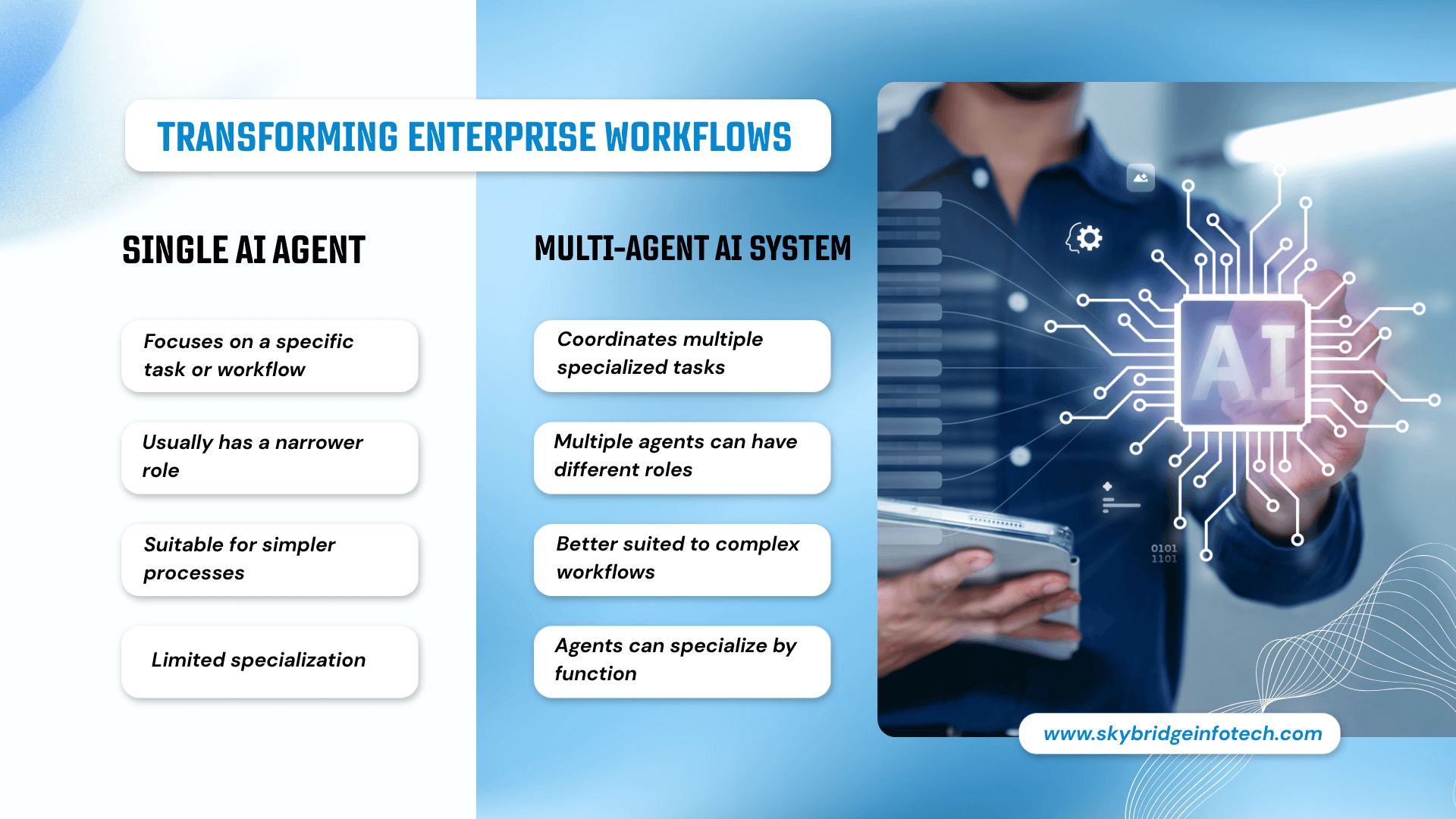
| Single AI Agent | Multi-Agent AI System |
| Focuses on a specific task or workflow | Coordinates multiple specialized tasks |
| Usually has a narrower role | Multiple agents can have different roles |
| Suitable for simpler processes | Better suited to complex workflows |
| Limited specialization | Agents can specialize by function |
| Less coordination required | Agents communicate and collaborate |
This doesn’t mean multi-agent AI is always the better choice.
For a simple task, one agent may be enough. For complex enterprise workflows involving multiple systems and decisions, a multi-agent architecture can provide greater flexibility.
Key Benefits of Multi-Agent AI for Enterprises
Organizations exploring multi-agent AI systems for enterprises are often looking for improvements across several areas.
Greater Productivity
AI agents can take care of repetitive activities, allowing employees to spend more time on strategy, creativity, customer relationships, and problem-solving.
Faster Workflow Execution
When multiple tasks can be handled simultaneously by specialized agents, processes can move faster than workflows that depend entirely on sequential manual actions.
Better Scalability
As business operations grow, organizations can potentially add new agents or capabilities without redesigning every workflow from scratch.
Improved Consistency
AI agents can follow predefined business rules, access approved information, and execute routine processes consistently.
More Personalized Customer Experiences
AI agents can analyze customer information and context to support more relevant interactions across different touchpoints.
Reduced Operational Workload
By handling repetitive coordination and information-processing tasks, AI agents can reduce the administrative burden on employees.
What Does a Multi-Agent Enterprise Workflow Look Like?
A typical workflow might look something like this:
Business Request
↓
Orchestrator Agent
↓
Specialized AI Agents
- Data collection agent
- Analysis agent
- Decision-support agent
- Communication agent
- Compliance or validation agent
↓
Enterprise Systems
↓
Human Review When Needed
↓
Final Action
The exact architecture depends on the organization’s goals, systems, security requirements, and workflow complexity.
The important idea is that each agent has a defined responsibility while working toward a common outcome.
Human + AI: The Future of Enterprise Workflows
The most effective enterprise AI strategy isn’t necessarily about removing humans from the workflow.
In many cases, the better approach is human-AI collaboration.
AI agents can handle repetitive tasks, gather information, monitor processes, and recommend actions. Employees can provide judgment, handle exceptions, make important decisions, and manage situations that require empathy or business context.
This creates a workflow where AI handles the operational workload while people remain responsible for meaningful decisions.
For enterprises, this balance is particularly important when workflows involve sensitive information, financial decisions, compliance requirements, or customer relationships.
Challenges Enterprises Need to Consider
Despite its potential, multi-agent AI isn’t something organizations should implement without careful planning.
Security and Access Control
AI agents may need access to enterprise applications and information. Organizations need strong identity, permission, and access-control mechanisms to ensure that agents only perform authorized actions.
Data Privacy
Enterprise AI systems may interact with sensitive customer, employee, financial, or operational information. Data protection needs to be built into the architecture from the beginning.
Governance and Monitoring
Organizations need visibility into what AI agents are doing, which tools they are using, and why specific actions are being taken.
Integration Complexity
Connecting AI agents with existing enterprise systems can require significant technical planning, particularly when organizations rely on legacy applications.
Human Oversight
Not every decision should be fully automated. Enterprises should identify situations where human approval or intervention is required.
How Businesses Can Start With Multi-Agent AI
Organizations don’t need to transform every workflow overnight.
A practical approach is to begin with one clearly defined process.
Start by identifying a workflow that:
- Has repetitive manual work
- Involves multiple steps
- Requires information from different systems
- Has measurable performance outcomes
- Doesn’t introduce unnecessary risk when starting with AI
Next, identify which tasks could be handled by AI agents and which should remain under human control.
From there, businesses can test the workflow, measure results, improve the system, and gradually expand AI capabilities.
This incremental approach can make enterprise AI adoption more manageable and measurable.
The Future of Multi-Agent AI in Enterprise Operations
Multi-agent AI is moving enterprise automation beyond simple rule-based processes.
Instead of asking AI to complete one isolated task, organizations can build systems where specialized agents collaborate to achieve broader business objectives.
As AI technology continues to evolve, we can expect multi-agent systems to become increasingly connected with enterprise applications, data platforms, and business processes.
The organizations that benefit most will likely be those that focus not just on deploying AI, but on redesigning workflows around responsible human-AI collaboration.
Final Thoughts
Multi-agent AI systems for enterprises have the potential to change how organizations approach automation, productivity, and decision-making.
By allowing specialized AI agents to collaborate, businesses can automate complex workflows, connect different systems, support employees, and respond to customers more efficiently.
However, successful adoption isn’t simply about adding more AI. It requires the right architecture, security controls, governance, integration strategy, and human oversight.
For enterprises exploring the next generation of intelligent automation, multi-agent AI represents an important step toward more adaptive and connected workflows.
Skybridge Infotech can help businesses explore how AI agents for enterprise workflows can be applied to real-world business processes, helping organizations move from isolated AI experiments toward practical, scalable enterprise AI solutions.