AI-Driven Application Development: Building Enterprise Apps 5x Faster
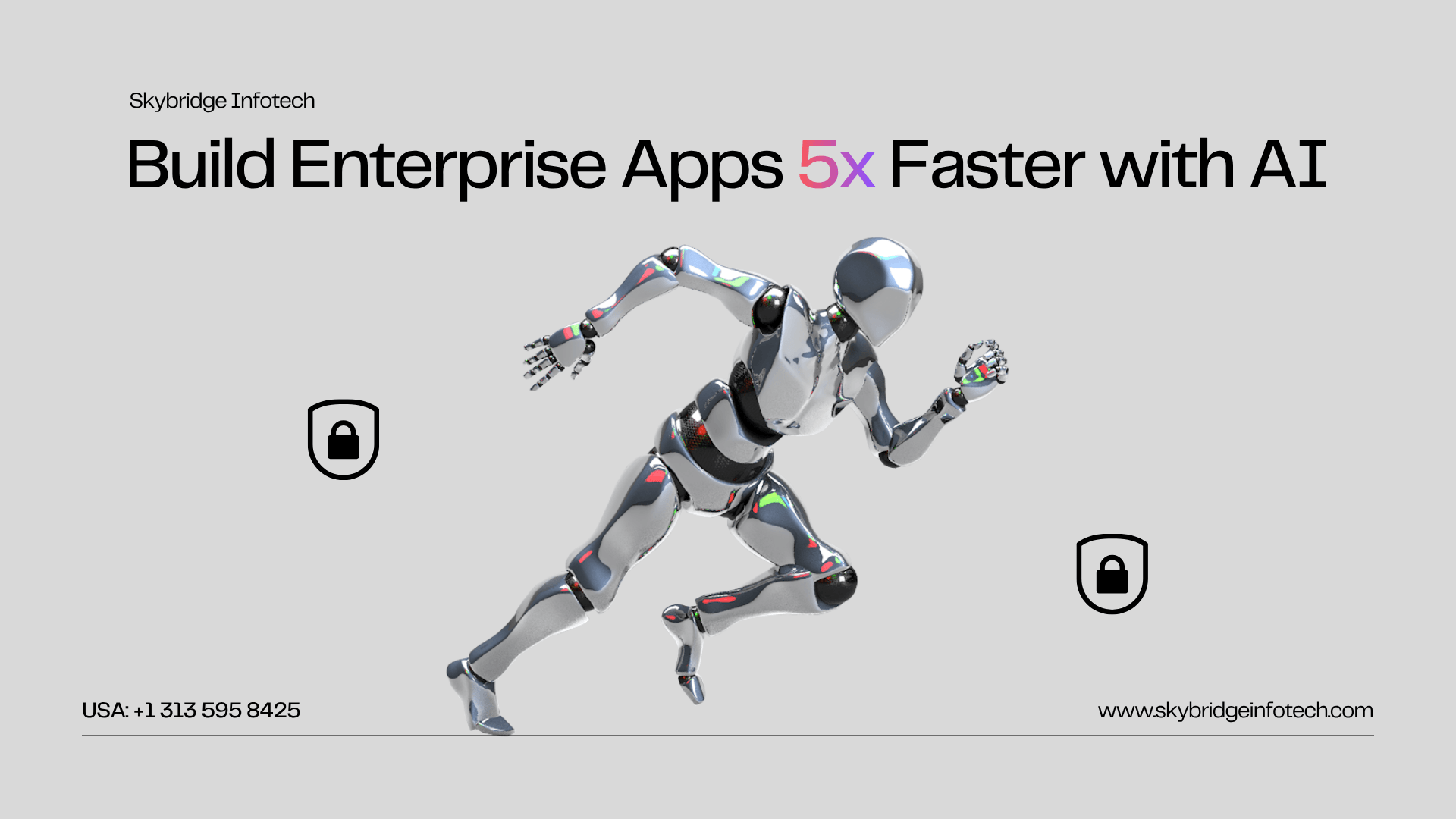
Enterprise application development is changing rapidly. Businesses no longer have to spend months moving from requirements and design to development, testing, and deployment. With the right combination of artificial intelligence, automation, modern development frameworks, and experienced engineering teams, enterprises can build and launch applications significantly faster.
AI-driven application development brings AI into the software development lifecycle—not simply as a chatbot or standalone feature, but as a practical technology that helps teams plan, build, test, optimize, and maintain applications more efficiently.
For enterprises looking to modernize their technology landscape, this approach can help reduce development effort, accelerate time to market, and create applications that are more intelligent, scalable, and responsive to business needs.
What Is AI-Driven Application Development?
AI-driven application development is the use of artificial intelligence across different stages of the application development lifecycle.
Instead of relying entirely on manual development processes, teams can use AI to assist with:
- Requirements analysis and application planning
- UI and UX development
- Code generation and code optimization
- API and integration development
- Automated testing
- Bug detection and troubleshooting
- Documentation
- Data analysis
- Application monitoring
- Workflow automation
- Intelligent application features
The goal is not to replace developers. The goal is to give development teams intelligent tools that handle repetitive work, accelerate decision-making, and allow engineers to spend more time solving complex business problems.
Why Enterprises Are Moving Toward AI-Powered Development
Traditional enterprise application development often involves multiple stages, teams, approval cycles, and dependencies. Even a relatively straightforward application can take months to move from an initial concept to production.
AI can help reduce friction across this lifecycle.
For example, developers can use AI-assisted coding tools to generate application components, create test cases, identify potential issues, and produce technical documentation. Business teams can use AI to turn requirements into clearer functional specifications. QA teams can automate portions of testing and identify defects earlier.
This creates a more connected development process where teams can move from an idea to a working application faster.
The biggest benefits include:
Faster development: AI-assisted development can reduce the time spent on repetitive coding and documentation tasks.
Lower development effort: Automation can reduce manual work across coding, testing, and maintenance.
Better developer productivity: Developers can focus on architecture, business logic, security, and complex engineering challenges.
Faster time to market: Applications can move through development and testing cycles more efficiently.
Improved scalability: AI can support modern architectures designed for changing enterprise workloads.
Continuous optimization: AI-powered monitoring and analytics can help identify performance and operational issues after deployment.
How AI Can Help Build Enterprise Applications 5x Faster
The idea of building an application “5x faster” should not be interpreted as a guaranteed result for every project. The actual improvement depends on application complexity, existing systems, development practices, data, integrations, and team expertise.
However, AI can create substantial productivity gains when it is applied across the entire development lifecycle rather than being used only for code generation.
1. Turn Business Requirements Into Development Tasks
Enterprise projects often begin with lengthy business requirements, functional specifications, user stories, and process documentation.
AI can help analyze these inputs and convert them into structured development requirements.
For example, an AI-assisted development workflow can help identify:
- Functional requirements
- User roles
- Application workflows
- Business rules
- API requirements
- Data requirements
- Potential edge cases
- Testing scenarios
This gives development teams a clearer starting point and can reduce the time spent translating business requirements into technical tasks.
2. Accelerate Application Design
AI can assist development teams in creating application architectures, database structures, API specifications, workflows, and UI concepts.
Developers can provide high-level requirements and use AI to generate initial technical approaches that engineers can review and refine.
This does not eliminate architectural decision-making. Instead, it gives architects and developers a faster starting point.
3. Speed Up Coding
One of the most visible applications of AI in software development is AI-assisted coding.
Developers can use AI to generate:
- Functions and classes
- API endpoints
- Database queries
- Front-end components
- Integration code
- Configuration files
- Unit tests
- Documentation
Developers remain responsible for reviewing, testing, securing, and integrating the generated code.
The benefit comes from reducing repetitive coding work while allowing engineers to concentrate on application architecture and business-critical functionality.
4. Automate Testing
Testing can become one of the biggest bottlenecks in enterprise application development.
AI can assist with generating test cases, identifying edge cases, analyzing test failures, and automating repetitive testing activities.
AI-powered testing can support:
- Unit testing
- API testing
- Functional testing
- Regression testing
- Performance testing
- Test case generation
- Defect analysis
When testing becomes part of the development workflow from the beginning, teams can identify issues earlier instead of discovering them shortly before deployment.
5. Improve Debugging and Code Quality
Developers can spend significant time finding the cause of application errors.
AI can analyze code, logs, error messages, and application behavior to help identify potential causes and suggest fixes.
For enterprise development teams, this can shorten troubleshooting cycles and help engineers resolve issues more efficiently.
6. Accelerate Documentation
Enterprise applications require extensive documentation for developers, administrators, support teams, and business users.
AI can help generate and maintain:
- API documentation
- Technical documentation
- Code explanations
- Release notes
- User documentation
- Configuration guides
This reduces the burden of manually documenting every development change.
AI Application Development Services for Modern Enterprises
Organizations looking to adopt AI-driven development often need more than an AI coding assistant. They need a structured approach that connects AI capabilities with their business objectives and existing technology ecosystem.
AI application development services can include:
AI-Powered Custom Application Development
Build custom applications around specific business processes, workflows, and operational requirements.
AI Integration Services
Connect AI capabilities with existing enterprise applications, APIs, databases, cloud platforms, and business systems.
Generative AI Application Development
Create applications using generative AI for content generation, knowledge retrieval, summarization, intelligent search, document processing, and business assistance.
AI Copilot Development
Develop intelligent copilots that help employees access information, complete tasks, analyze data, and make faster decisions.
Intelligent Workflow Automation
Use AI and automation to streamline repetitive business processes and reduce manual intervention.
AI-Powered Data Applications
Build applications that use enterprise data to generate insights, predictions, recommendations, and intelligent business actions.
Enterprise AI Application Development: What Makes It Different?
Building an AI-powered enterprise application is different from building a basic consumer application.
Enterprise applications need to work within existing technology ecosystems while meeting requirements for security, governance, scalability, compliance, and reliability.
An effective enterprise AI application development strategy should consider:
Security: Protect enterprise data, credentials, APIs, and application access.
Governance: Establish clear policies for AI usage, data access, model behavior, and human oversight.
Integration: Connect AI applications with existing ERP, CRM, databases, cloud services, and internal systems.
Scalability: Ensure the application can handle growing users, data volumes, and workloads.
Reliability: Design appropriate monitoring, fallback mechanisms, and error handling.
Data quality: AI applications are only as effective as the data and knowledge they can access.
Human oversight: Keep people involved in important decisions where accuracy, accountability, or business risk matters.
AI Development Services: From Idea to Production
A successful AI application requires more than selecting an AI model.
The development process should connect business objectives, application architecture, data, AI capabilities, security, and user experience.
A typical AI development journey can include:
Step 1: Identify the Business Opportunity
Start with the business problem rather than the technology.
Identify processes where AI can deliver measurable value, such as reducing manual effort, improving customer experiences, accelerating decision-making, or increasing operational efficiency.
Step 2: Assess Data and Technology
Evaluate existing applications, data sources, APIs, infrastructure, security requirements, and integration points.
Step 3: Define the AI Strategy
Select the appropriate AI approach based on the use case. This could include generative AI, machine learning, intelligent automation, AI agents, predictive analytics, or a combination of technologies.
Step 4: Build an MVP
Develop a focused minimum viable product to validate the use case before making a large-scale investment.
Step 5: Integrate With Enterprise Systems
Connect the AI application with the organization’s existing technology environment.
Step 6: Test and Govern
Evaluate accuracy, security, performance, reliability, and responsible AI requirements.
Step 7: Deploy and Scale
Move the application into production and continuously monitor its performance, usage, and business impact.
Traditional Development vs. AI-Driven Development
| Traditional Application Development | AI-Driven Application Development |
| Heavy manual coding | AI-assisted development |
| Manual requirement analysis | AI-assisted requirement analysis |
| Manual test creation | AI-assisted test generation |
| Manual documentation | Automated documentation support |
| Longer development cycles | Faster development iterations |
| Reactive troubleshooting | AI-assisted debugging |
| Separate development activities | More integrated development workflow |
| Limited automation | Automation across the lifecycle |
The objective is not to eliminate traditional software engineering practices. Instead, AI enhances them.
How Skybridge Infotech Helps Enterprises Build AI Applications
At Skybridge Infotech, AI-driven application development is focused on combining modern application engineering with practical AI capabilities.
Our approach is designed to help enterprises move from an initial business idea to a scalable production application while considering existing technology investments.
Our AI development services can support organizations across:
- AI strategy and use-case identification
- AI application development
- Generative AI solutions
- Enterprise AI implementation
- AI-powered workflow automation
- AI copilots and intelligent assistants
- AI integration with enterprise systems
- Custom application development
- Data and analytics integration
- AI governance and responsible AI
- Application modernization
Rather than treating AI as an isolated technology layer, we focus on how AI can become part of the application’s overall business workflow.
Building Enterprise AI Solutions That Deliver Business Value
The best enterprise AI solutions are not necessarily the most technically complex.
They are the ones that solve a meaningful business problem.
Before implementing AI, enterprises should ask:
- What business problem are we solving?
- How much manual effort can be reduced?
- What data will the application need?
- How will users interact with AI?
- What systems need to be integrated?
- How will accuracy be measured?
- What security and governance controls are required?
- How will we measure ROI?
These questions help organizations avoid implementing AI simply because it is available and instead focus investment on measurable outcomes.
The Future of Enterprise Application Development Is AI-Assisted
AI is changing how software is designed, developed, tested, deployed, and maintained.
For enterprises, the opportunity goes beyond generating code faster. AI can help create a more efficient development lifecycle where teams can move from business requirements to production applications with fewer manual bottlenecks.
Organizations that combine AI application development services, modern engineering practices, strong architecture, and responsible AI governance can create a significant advantage in speed and innovation.
The goal is simple: build better enterprise applications, reduce unnecessary development effort, and bring valuable digital solutions to users faster.
Ready to Accelerate Enterprise Application Development?
If your organization is exploring AI-driven application development, the right starting point is not simply choosing an AI tool. It is identifying where AI can create measurable value across your application development lifecycle.
Skybridge Infotech can help you evaluate AI opportunities, design an AI development strategy, build custom AI applications, and integrate intelligent capabilities into your enterprise environment.